Balancing intricate customization with profitable efficiency remains the defining challenge for specialty manufacturers, and it’s one Maryland MEP hears about constantly. Maryland’s industrial sector features a wealth of companies producing highly specialized, low-volume goods, and we’ve worked alongside many of them. Labor shortages, rising material costs, and the inability to scale using traditional mass-production techniques create constant pressure on profit margins.
By strategically adopting flexible technologies, Maryland specialty manufacturers can effectively automate small batch production. Through our Process & Innovation and Technology & Cybersecurity services, we help manufacturers upgrade their shop floors to scale operations profitably, without sacrificing the high quality and detailed customization your customers expect.
The Core of Small Batch Production
Defining and understanding the value of small batch production is critical before attempting to innovate your existing processes. Small batch production involves manufacturing goods in limited quantities, with facilities typically focusing on customized, built-to-order items rather than mass-market commodities.
This approach offers distinct advantages. It drastically reduces inventory overhead, freeing up vital warehouse space and capital, while allowing engineering teams to execute rapid design iterations based on immediate customer feedback. Meeting niche market demands becomes much easier when you operate a lean, responsive production line.
However, traditional automation solutions usually fail in these low-volume environments. Legacy industrial robots rely on rigid programming and expensive tooling designed to churn out millions of identical parts over several years. When your product specifications change weekly or even daily, those legacy systems become costly obstacles, with every product changeover requiring hours of reprogramming and mechanical adjustments. That’s why a flexible approach to automation is essential for custom manufacturers, and exactly where Maryland MEP can help.
Technological Innovations for Flexible Manufacturing
Modern technological advancements provide adaptable solutions perfectly suited for custom manufacturing environments. You no longer need to buy massive, single-purpose machines. Today’s industrial technology focuses on agility that best fits your operations.
Collaborative Robots (Cobots)
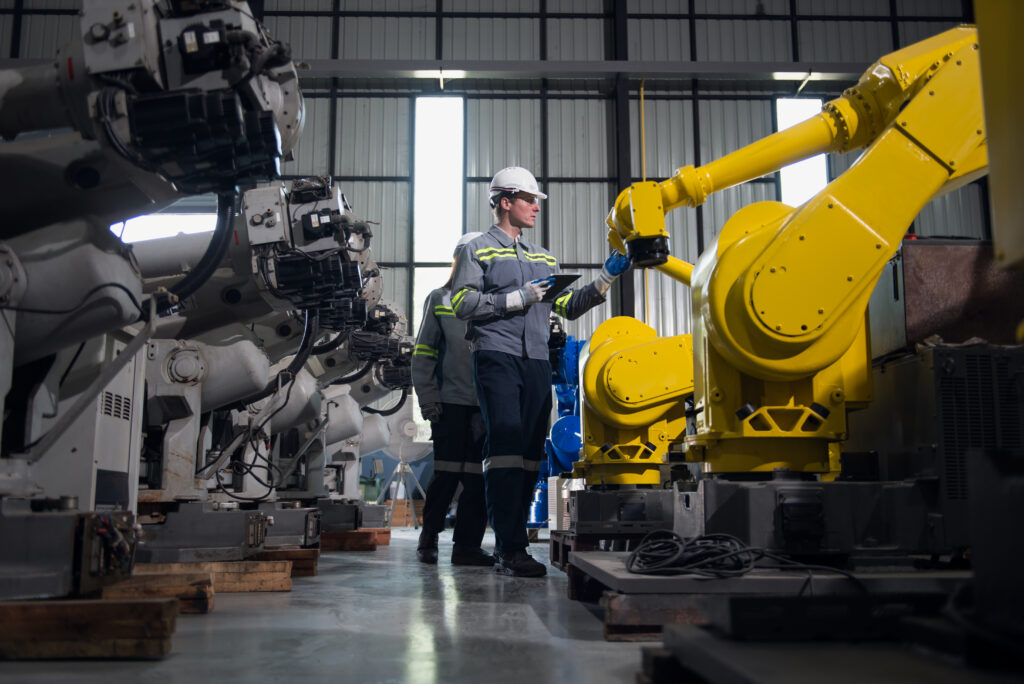
Collaborative robots, or cobots, represent a massive leap forward for flexible manufacturing. Unlike traditional industrial robots that operate behind heavy safety cages, cobots work safely alongside human operators using built-in force sensors that immediately stop the machine upon contact with a worker.
Cobots excel at taking over dull, dirty, and dangerous repetitive tasks like machine tending, pick-and-place operations, and basic assembly, freeing your skilled workforce to focus on complex custom finishing and quality assurance. They’re also remarkably easy to reprogram. Operators can often teach a cobot a new movement path simply by physically guiding the arm through the desired motions, making task changes between batches fast and practical.
Flexible Manufacturing Systems (FMS)
A Flexible Manufacturing System (FMS) brings ultimate agility to the factory floor through modular workstations and software-driven tool changes that accommodate varying product lines. Rather than a linear assembly line bolted to the floor, an FMS uses automated guided vehicles or mobile carts to route components between machining centers based on each batch’s specific requirements.
When a new run calls for a different set of operations, the software reroutes materials accordingly, minimizing costly downtime during changeovers between entirely different custom products.
Smart Sensors and Data Analytics
Maintaining strict quality control is notoriously difficult when product specifications change batch to batch. Smart sensors and data analytics address this through real-time production monitoring. Machine vision cameras automatically inspect parts for defects against CAD files, while sensors on CNC machines track vibration and temperature to predict tool wear before it ruins a custom piece of material. This data-driven approach ensures consistent quality across every run, regardless of design changes.
Actionable Steps for Implementation
Integrating automation into a custom manufacturing floor requires a strategic, phased approach. Maryland MEP guides manufacturing through exactly this kind of structured transition, protecting product quality and cash flow at every step.
Conduct Thorough Process Mapping
You must fully understand your current operations before you can automate them. Process mapping involves documenting every single step a product takes from raw material to final packaging.
Analyze this map to identify specific bottlenecks holding up your entire facility. Look for highly repetitive sub-processes embedded within larger custom jobs. For example, your final product might be highly customized, but the initial material cutting process might be standardized. These repetitive sub-processes serve as prime candidates for your first automation efforts.
Start Small and Adapt
Resist the urge to overhaul your entire production line at once. We recommend starting with a single pilot project to prove the concept and build employee confidence. Automated material handling is often the ideal entry point. Deploying an autonomous mobile robot (AMR) to move heavy parts from the warehouse to the machining center removes a simple bottleneck without disrupting the actual fabrication process. Once this pilot project demonstrates a positive return on investment, you can confidently scale up to more complex automated tasks.
Upskill Your Workforce
Automation does not mean replacing your workforce; it means elevating them. This is a principle we build our Talent & Workforce programs around. New flexible systems require human intelligence to program, monitor, and maintain the equipment.
Our Manufacturing Skills Training Program and Future Leaders Program provide structured pathways to turn floor workers into skilled machine operators and robot programmers. Your employees already know how your custom products should look and feel. Teaching them to use cobots as a tool to achieve that standard makes your entire operation stronger.
Moving Forward with Process Innovation
Automating small batch production is no longer an oxymoron. Through collaborative robots, flexible manufacturing systems, and smart data analytics, paired with the right guidance, Maryland’s specialty manufacturers can fundamentally transform their floors while maintaining the standard of customized excellence their customers depend on.
Start by evaluating your current bottlenecks. Walk your shop floor and identify the repetitive tasks holding back your skilled team. Then, reach out to Maryland MEP to begin mapping a process innovation strategy built around your specific operation. The tools for flexible, profitable growth are readily available with Maryland MEP.
Leveraging Maryland's Economic Context and Resources
Maryland provides a robust ecosystem of resources to support specialty manufacturers through this transition, and Maryland MEP sits at the center of it.
Get Involved with Maryland MEP
Find out more about the resources available that can help your facility adopt flexible automation.